Every Arcadia listing with a green lawn and a citrus canopy eventually gets the same question from an out-of-state buyer: how much does it cost to keep this yard alive in the desert? The honest answer, based on SRP's own published residential water charge schedule, runs somewhere between $270 and $450 a year for a typical irrigated lot, billed twice annually. Against a seven-figure Arcadia purchase price, that number is closer to a rounding error than a real expense.
The water bill was never the problem. The problem shows up later, usually during design, when a survey finds that the pool a buyer has already sketched sits partly inside a canal easement nobody flagged before closing.
How Water Actually Reaches an Arcadia Lot
Arcadia's lush lots trace back to Arizona's first commercial citrus grove, planted here in 1899, irrigated through the Salt River Project's canal system long before the neighborhood was subdivided into the mid-century ranch homes that define it today.
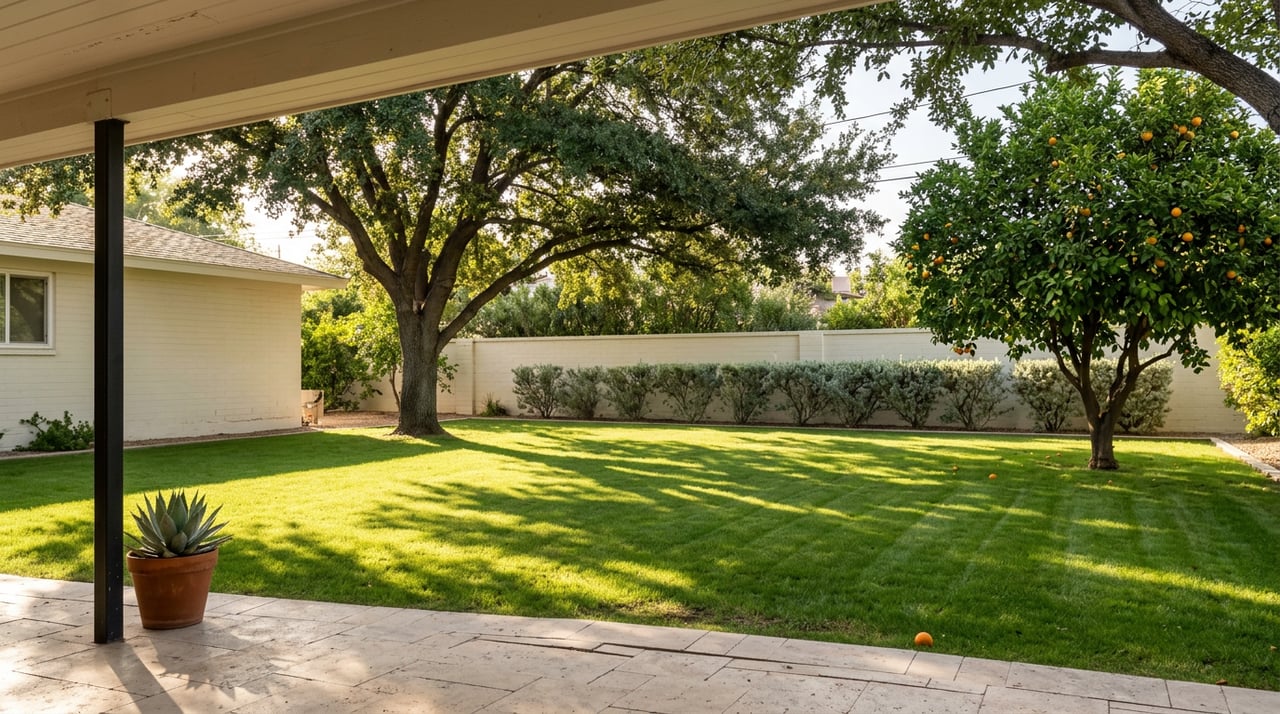
The mechanics are straightforward. Canal water moves from SRP's main system into neighborhood laterals, then reaches a lot through a small turnout or gate. Once it's on the property, gravity does the rest, spreading across the yard through shallow channels or berms rather than a pressurized sprinkler system. This water is not treated to drinking standards. It exists for one purpose: keeping turf, citrus, and shade trees green in a climate that would otherwise turn them brown by June.
On many blocks, several properties share a single turnout, coordinating through a fixed rotation or an informal neighborhood ditch group on who opens and closes the gate. Miss your scheduled turn and you may wait weeks for the next one. It's a small recurring responsibility, not a real financial burden, and most owners either handle it themselves or fold it into a landscaper's regular scope.
The Line Item That Actually Scares Buyers
Buyers moving from smaller lots elsewhere in the Valley tend to fixate on the irrigation fee because it's the one number attached to Arcadia's defining feature. It's also the wrong number to worry about.
Arizona's effective property tax rate runs close to 0.43 percent, less than half the roughly 0.89 percent national average. On a home priced near Arcadia Proper's July 2026 median of $1.545 million, that gap means an annual tax bill that would barely cover a few months of property tax on a comparable home in California or the Northeast. It's one of the few places where a bigger purchase price doesn't come with a proportionally bigger annual tax shock.
What does scale with the lot, and what buyers consistently underbudget, is maintenance. A third-acre-or-larger parcel costs meaningfully more to keep up than a standard subdivision yard, irrigation aside. Pool service, tree trimming on mature citrus and shade canopy, and general landscaping all grow with square footage. That's the real adjustment buyers moving from a smaller lot need to make, and it has nothing to do with the SRP bill.
Where the Real Risk Sits: The Easement
Here's the part that doesn't show up on a closing statement until it's already caused a delay.
This becomes a live issue the moment someone plans a pool, a guest house, or any significant grading change. If an improvement conflicts with an easement, the design may need to shift.
None of this kills a deal. It does eat weeks if nobody checks before the offer gets written.
Before finalizing any pool, ADU, or major grading plan on an irrigated Arcadia lot, work through this sequence:
- Confirm whether the specific parcel currently receives an active SRP delivery.
- Locate the turnout or gate and determine whether it sits inside the lot, an easement, or a public right-of-way.
- Request SRP's easement information for the parcel before finalizing any design that touches the yard.
- If a pool or ADU is planned, SRP lists pool clearance authorization and permission to encroach on an irrigation easement among its request options; get the review in writing before the design is locked.
- Ask whether the property shares a turnout with neighbors and, if so, who currently manages the rotation.
What to Request Before Writing an Offer
The documentation worth requesting before you write an offer, and what each piece actually tells you:
| Document | What it tells you |
|---|---|
| SRP account history and recent bills | Confirms the lot has an active delivery, not just a legacy right that lapsed years ago |
| Recorded easement or plat showing the turnout location | Shows whether a future pool, ADU, or addition has room to work around the easement |
| Any ditch group or shared-turnout agreement | Clarifies who else has rights to the same delivery point and how scheduling actually works |
| Prior SRP correspondence on pool or grading clearance | Reveals whether a past owner already resolved a conflict, or left one for you to inherit |
A seller who can hand over this packet up front signals a property that's been properly maintained and understood. One who can't isn't necessarily hiding anything, but it does mean the buyer's own due diligence has to fill the gap before removing contingencies.
Why This Matters More Than It Used To
Arcadia isn't adding inventory. It's a built-out neighborhood, and original-condition lots that do come to market typically sell inside a month because the development opportunity is structurally limited and builders compete aggressively for buildable irrigated parcels, according to July 2026 sales data for the ZIP. Teardown-to-rebuild projects commonly run 12 to 24 months from permit to certificate of occupancy, and cash buyers represented roughly a third of Arcadia transactions in the same period, rising above half of all deals at price points north of $3 million.
That combination, a market moving fast, dominated by cash and by buyers who often intend to redesign, means the easement question isn't a rare edge case. It's the exact scenario that plays out whenever someone buys an irrigated lot planning to add a pool or reconfigure the yard, which in Arcadia is close to the default plan rather than the exception.
The water rights that make Arcadia's lawns green are cheap to keep. The paperwork behind them is what determines whether your design timeline holds.
What This Means If You're Circling a Listing
If you're evaluating an irrigated Arcadia lot, treat the SRP question the same way you'd treat any other title or survey issue. Ask for the easement documentation before you fall in love with a pool design. Confirm the delivery is active before you budget for it. And don't let the modest size of the water bill lull you into skipping the one document that actually protects your renovation plans.
A Few Questions Worth Settling Early
How can I confirm whether a specific Arcadia home has flood irrigation? Confirm the specific address rather than assuming based on the neighborhood name.
Can I convert an irrigated lot to a standard sprinkler system? Often, but it typically requires coordination with SRP and the City of Phoenix, and a plan for how decommissioning affects any shared turnout arrangement with neighbors.
Does the irrigation easement show up on a standard title report? Recorded easements generally appear in title work, but the exact turnout location and whether a planned improvement conflicts with it usually requires a fresh survey and direct confirmation from SRP, not just a title search.
If you're looking at an irrigated lot in Arcadia and want a second set of eyes on the easement question before you write an offer, The Caniglia Group can help you get the right documentation together early. Schedule a Free Consultation and let's make sure the only surprise in your closing is how green the yard looks in July.
This article is general information, not legal, tax or financial advice. Consult a qualified professional about your situation.